Main article: Italian Armed Forces

The aircraft carrier MM Cavour
The Italian Army is the national ground defence force, numbering 109,703 in 2008. Its best-known combat vehicles are the Dardo infantry fighting vehicle, the Centauro tank destroyer and the Ariete tank, and among its aircraft the Mangusta attack helicopter, recently deployed in UN missions. It also has at its disposal a large number of Leopard 1 and M113 armoured vehicles.

A Eurofighter Typhoon operated by the Italian Air Force
The Italian Air Force in 2008 had a strength of 43,882 and operated 585 aircraft, including 219 combat jets and 114 helicopters. As a stopgap and as replacement for leased Tornado ADV interceptors, the AMI has leased 30 F-16A Block 15 ADF and four F-16B Block 10 Fighting Falcons, with an option for more. The coming years will also see the introduction of 121 EF2000 Eurofighter Typhoons, replacing the leased F-16 Fighting Falcons. Further updates are foreseen in the Tornado IDS/IDT and AMX fleets. A transport capability is guaranteed by a fleet of 22 C-130Js and Aeritalia G.222s of which 12 are being replaced with the newly developed G.222 variant called the C-27J Spartan.
An autonomous corps of the military, the Carabinieri are the gendarmerie and military police of Italy, policing the military and civilian population alongside Italy's other police forces. While the different branches of the Carabinieri report to separate ministries for each of their individual functions, the corps reports to the Ministry of Internal Affairs when maintaining public order and security.[116]
Administrative divisions
Main articles: Regions of Italy, Metropolitan cities of Italy, Provinces of Italy, and Municipalities of Italy
Italy is subdivided into 20 regions (regioni), five of these regions having a special autonomous status
that enables them to enact legislation on some of their local matters.
The country is further divided into 14 metropolitan cities (città metropolitane) and 96 provinces (province), which in turn are subdivided in 8,047 municipalities (comuni).[117]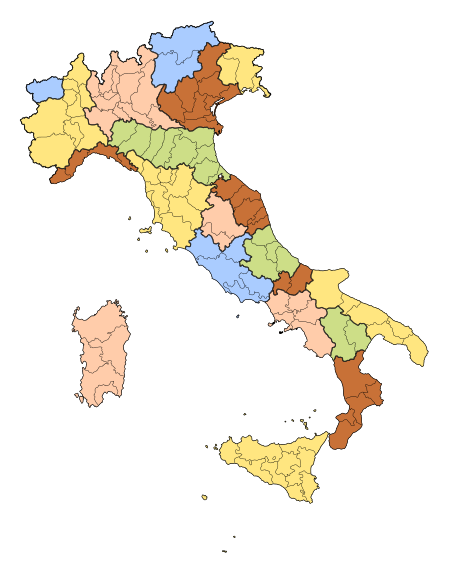
| Region | Capital | Area (km²) | Area (sq mi) | Population |
|---|---|---|---|---|
| Abruzzo | L'Aquila | 10,763 | 4,156 | 1,331,574 |
| Aosta Valley | Aosta | 3,263 | 1,260 | 128,298 |
| Apulia | Bari | 19,358 | 7,474 | 4,090,105 |
| Basilicata | Potenza | 9,995 | 3,859 | 576,619 |
| Calabria | Catanzaro | 15,080 | 5,822 | 1,976,631 |
| Campania | Naples | 13,590 | 5,247 | 5,861,529 |
| Emilia-Romagna | Bologna | 22,446 | 8,666 | 4,450,508 |
| Friuli-Venezia Giulia | Trieste | 7,858 | 3,034 | 1,227,122 |
| Lazio | Rome | 17,236 | 6,655 | 5,892,425 |
| Liguria | Genoa | 5,422 | 2,093 | 1,583,263 |
| Lombardy | Milan | 23,844 | 9,206 | 10,002,615 |
| Marche | Ancona | 9,366 | 3,616 | 1,550,796 |
| Molise | Campobasso | 4,438 | 1,713 | 313,348 |
| Piedmont | Turin | 25,402 | 9,808 | 4,424,467 |
| Sardinia | Cagliari | 24,090 | 9,301 | 1,663,286 |
| Sicily | Palermo | 25,711 | 9,927 | 5,092,080 |
| Tuscany | Florence | 22,993 | 8,878 | 3,752,654 |
| Trentino-Alto Adige/Südtirol | Trento | 13,607 | 5,254 | 1,055,934 |
| Umbria | Perugia | 8,456 | 3,265 | 894,762 |
| Veneto | Venice | 18,399 | 7,104 | 4,927,596 |
Economy
Main article: Economy of Italy

A Ferrari 488, produced by the world's most powerful brand Ferrari.[118] Italy maintains an innovative automotive industry, and is one of the largest exporters of manufactured goods.
Italy is regarded as one of the world's most industrialised nations and a leading country in world trade and exports.[120][121][122] It is a highly developed country, with the world's 8th highest quality of life in 2005[123] and the 25th Human Development Index. The country is well known for its creative and innovative business,[124] a large and competitive agricultural sector[125] (Italy is the world's largest wine producer),[126] and for its influential and high-quality automobile, machinery, food, design and fashion industry.[127][128][129]

Boxes of Ferrero Rocher, manufactured by Ferrero, the third biggest chocolate producer and confectionery company in the world[130]
The country was the world's 7th largest exporter in 2009.[133] Italy's closest trade ties are with the other countries of the European Union, with whom it conducts about 59% of its total trade. Its largest EU trade partners, in order of market share, are Germany (12.9%), France (11.4%), and Spain (7.4%).[134] Finally, tourism is one of the fastest growing and profitable sectors of the national economy: with 48.6 million international tourist arrivals and total receipts estimated at $45.5 billion in 2014, Italy was the fifth most visited country and the sixth highest tourism earner in the world.[135]

Italy is part of a monetary union, the Eurozone (dark blue) and of the EU single market
Italy has been hit very hard by the Financial crisis of 2007–08 and the subsequent European sovereign-debt crisis, that exacerbated the country's structural problems.[138] Effectively, after a strong GDP growth of 5–6% per year from the 1950s to the early 1970s,[139] and a progressive slowdown in the 1980-90s, the country virtually stagnated in the 2000s.[140][141] The political efforts to revive growth with massive government spending eventually produced a severe rise in public debt, that stood at over 135% of GDP in 2014, ranking second in the EU only after the Greek one (at 174%).[142] For all that, the largest chunk of Italian public debt is owned by national subjects, a major difference between Italy and Greece,[143] and the level of household debt is much lower than the OECD average.[144]
A gaping North–South divide is a major factor of socio-economic weakness.[145] It can be noted by the huge difference in statistical income between the northern and southern regions and municipalities.[146] The richest region, Lombardy, earns 127% of the national GDP per capita, while the poorest, Calabria, only 61%[147] The unemployment rate (11.9%) stands slightly above the Eurozone average,[148] however the average figure is 7.9% in the North and 20.2% in the South.[149]


